
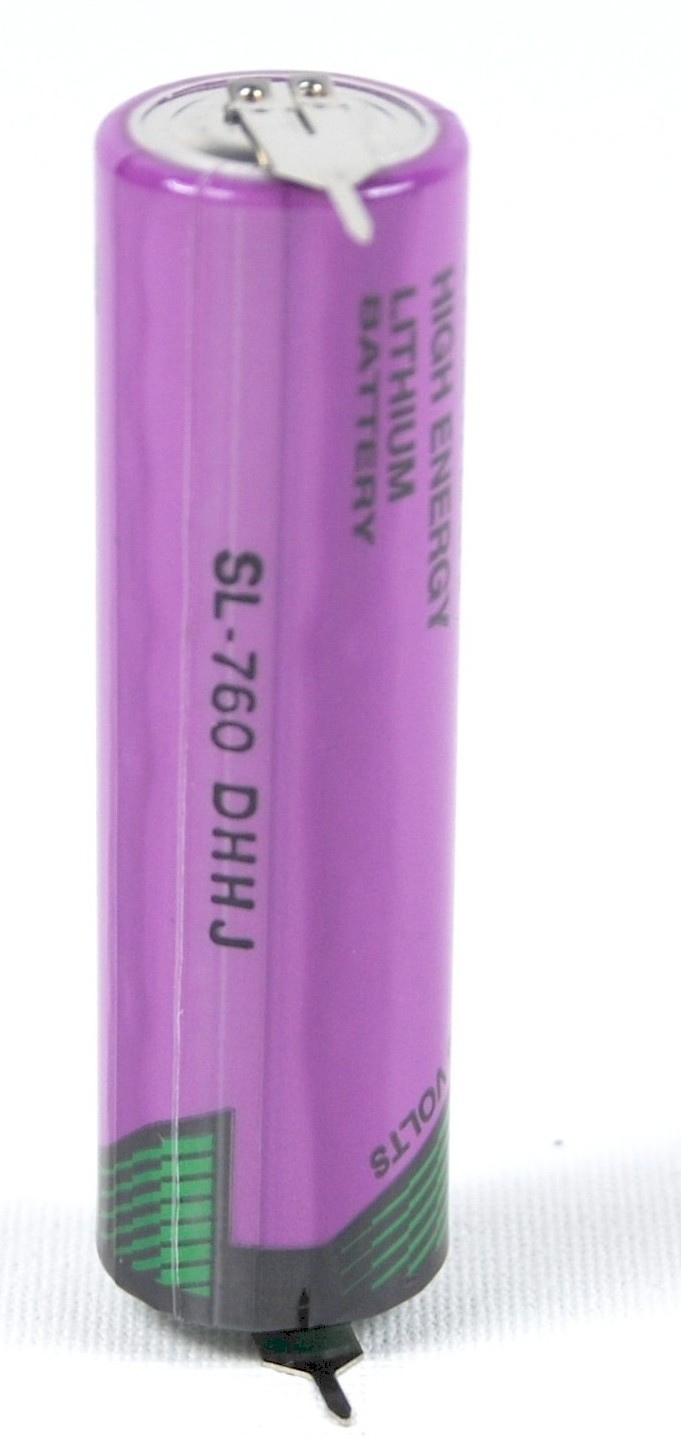
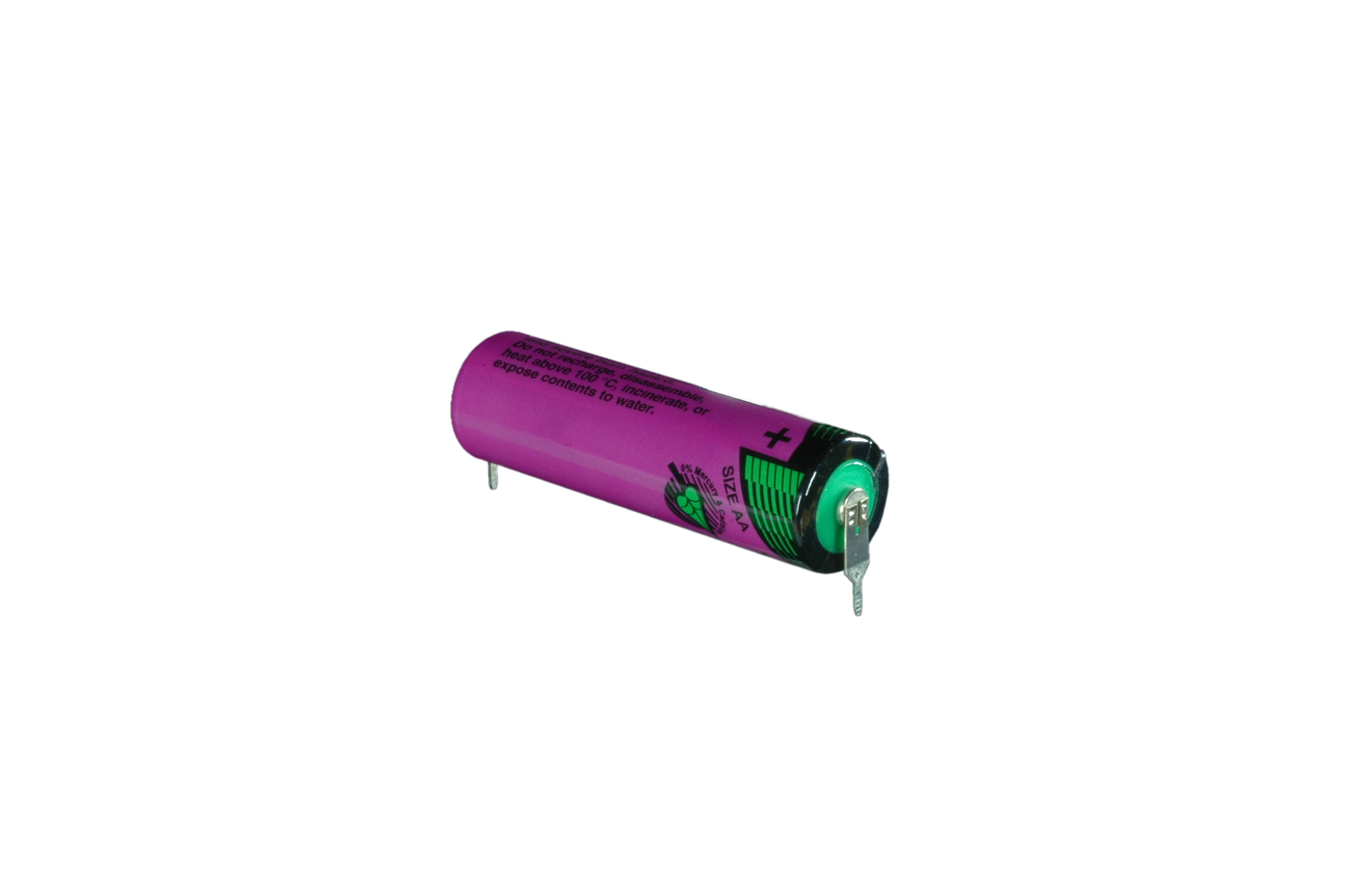

Tadiran SL-760PR Lithium battery AA with 3.6 V and 2.2 Ah, with radial pins
Product information
The Tadiran SL-760PR is a primary high-performance lithium thionyl chloride battery in the widely used size AA (Mignon). As part of the proven SL-700 series, it is optimised for maximum reliability and an extremely long service life with minimum self-discharge. This version is pre-configured with radial pins (+/- 1 pin) for the direct and secure mounting on PCBs. With a nominal voltage of 3.6 V and a high capacity of 2.2 Ah, it is the ideal energy solution for professional "fit and forget" applications.
Highlights at a glance
- Maximum longevity: Extremely low self-discharge of less than 1% per year.
- For PCB mounting: Pre-configured with radial pins (+/- 1 pin) for direct installation.
- High capacity: 2.2 Ah in standardised AA (Mignon) format.
- High rated voltage: Stable voltage of 3.6 V throughout almost the entire service life.
- Wide temperature range: Reliable operation from -55°C to +85°C.
Powerful in a wide range of applications
The Tadiran SL-760PR was specifically developed for long-term applications with low continuous current, in which the battery is permanently integrated into the electronics. The radial pins enable a specific and space-saving arrangement on the PCB. Its primary areas of application include memory backups (RTC, CMOS) in industrial control systems (PLC), metering technology (metering for water, gas, electricity) as well as long-life security technology and alarm systems in the common AA format.
Designed for maximum safety and efficiency
The safety and longevity of the SL-760PR are based on the proven Tadiran design. The cell has a hermetic glass-to-metal seal that reliably prevents the electrolyte from leaking. The inorganic electrolyte used is non-flammable and ensures a high degree of intrinsic safety. Each cell is designed to deliver its energy constantly and safely over a very long period of time, reducing maintenance costs and the total operating costs of your application.
Superior lithium thionyl chloride technology
The lithium thionyl chloride technology (Li-SOCl₂) of the SL-700 series is the gold standard for long-term applications with low current requirements. A characteristic feature is the passivation effect: a thin protective layer forms on the lithium anode, which reduces the self-discharge to an absolute minimum, enabling extremely long storage and operational capability. This ensures that energy is reliably available even after many years.
Features
| Model | Tadiran SL-760/PR |
| Technology | Lithium thionyl chloride (Li-SOCl₂) |
| Size | AA (Mignon) |
| Rated voltage (V) | 3.6 |
| Capacity (mAh) | 2200 |
| Max. continuous discharge current | 100 mA |
| Self-discharge | approx. 1% per year |
| Operating temperature (°C) | -55 ~ +85 |
| Dimensions (Ø x L, mm) | approx. 14.7 x 50.5 |
| Weight (g) | approx. 18 |
| Connection | Radial pins (PR) |
| Rechargeable | No |
FAQs about this Tadiran battery
What does the connection with "radial pins" mean?
In contrast to axial connections, which exit from the centre of the terminals, radial pins are arranged so that they exit from one face of the battery. This configuration is optimised for specific layouts on printed circuit boards (PCBs) and enables particularly stable and defined mounting of the cell.
What is the advantage of the SL-700 series over other series?
The SL-700 series is optimised for the absolute lowest self-discharge. It is the best choice for applications that require very little power over many years, such as memory backup in computers. In contrast, other series (such as the SL-300 iXtra) are designed for applications with higher pulse current demand.
For which devices is this battery type suitable?
This battery type is ideal for professional electronics in which the battery is permanently soldered and an extremely long service life is decisive. Typical applications are meters, industrial computers, alarm systems and long-life sensors with specific PCB layouts.
Is this battery rechargeable?
No, this is a primary lithium battery and must not be recharged under any circumstances. Attempting to charge the cell is dangerous and can lead to overheating, leakage or rupture of the cell.
What does the passivation effect mean for this battery?
After longer storage, a protective layer forms on the lithium surface. This layer is the reason for the extremely low self-discharge. On first use, it can lead to a short voltage delay. This should be considered in circuit design for applications that require current immediately after activation.
Login