Mounting material
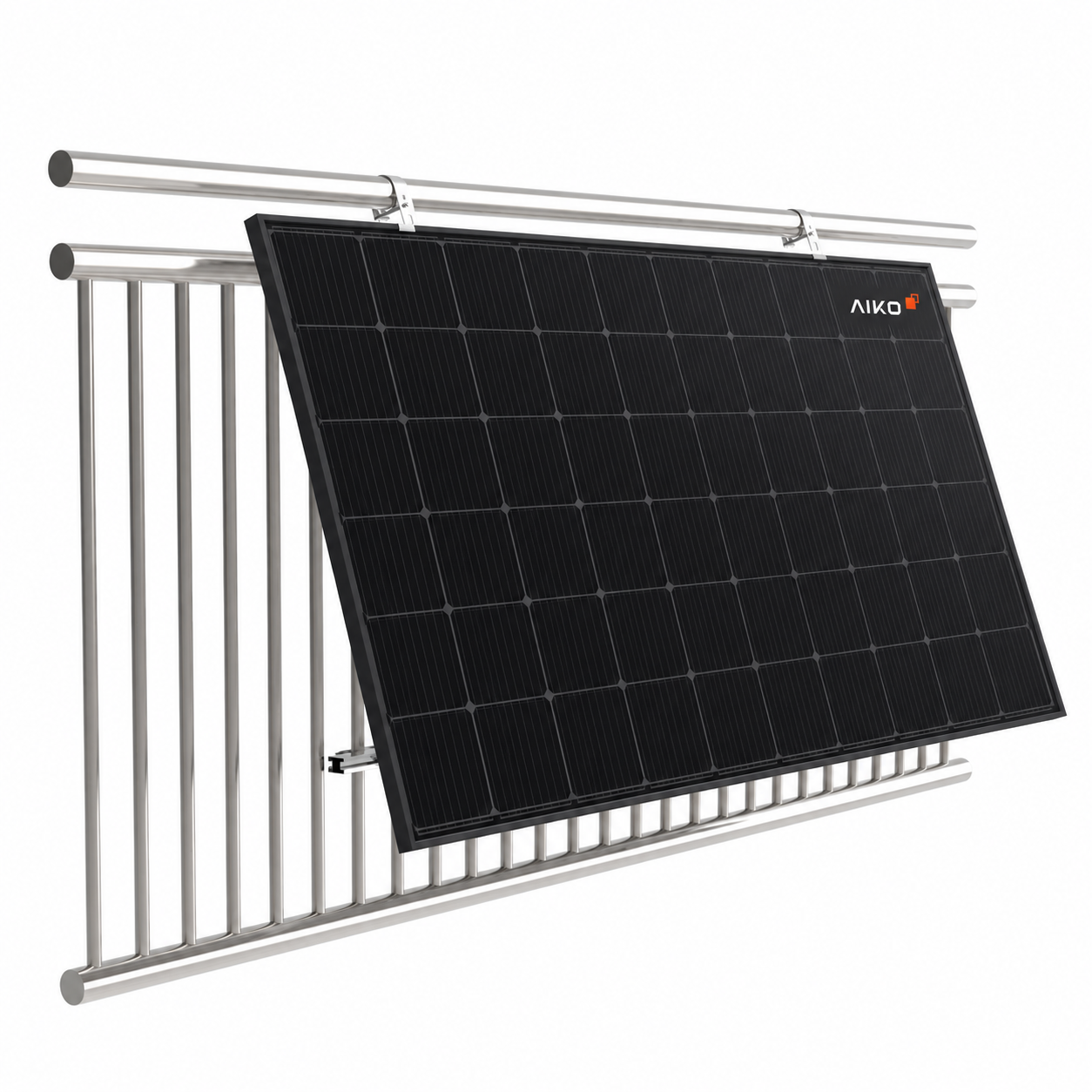
Harness the power of the sun directly on your balcony railing with the easily adjustable solar balcony mounting bracket from KSENG. This innovative racking system has been specially developed for the simple and safe installation of standard solar modules on balconies. Thanks to the adjustable tilt angle, you can optimise the energy yield of your mini solar system and thus actively contribute to the energy transition and reduce your electricity costs. The elegant black anodised finish also ensures an attractive appearance.Highlights at a glanceSimple installation: Sophisticated design for quick and easy self-installation on the balcony railing without drilling.Adjustable tilt angle: Enables the solar module to be optimally aligned with the sun for maximum energy yield at any time of year (e.g. 0-30 degrees).Robust materials: Manufactured from high quality, corrosion resistant aluminium alloy and stainless steel for maximum durability and weather resistance.Elegant look: Black anodised for a modern and unobtrusive appearance on the balcony.Universal compatibility: Suitable for most standard solar modules and suitable for various balcony railing types (round, square).Secure attachment: Stable clamping and hook system ensures a firm and secure hold of the solar module.Your entry into solar energy – directly on the balconyThis mounting system makes it easier than ever to start generating your own solar power. Attach your solar panel securely and efficiently to your balcony railing and produce environmentally friendly electricity for your household. Ideal for tenants and homeowners who want to make a contribution to the energy revolution and reduce their electricity bills without having to carry out costly roof installations.Maximum yield thanks to optimum alignmentThe key advantage of this bracket is the adjustable tilt angle. Simply adjust the orientation of your solar panel to the position of the sun – steeper in winter, flatter in summer. This allows you to maximise the solar radiation on the module and get the most energy out of your balcony solar system, resulting in faster amortisation.Stable and secure mounting made easyThe KSENG balcony mounting system is designed for easy do-it-yourself installation. The robust hooks are securely attached to the railing and the clamps hold the solar module firmly in the bracket. All required fastening elements are usually included in the scope of delivery. The use of weatherproof aluminium and stainless steel guarantees a long service life and safe operation for many years. Features ModelKSENG Adjustable universal solar mounting bracket ApplicationMounting solar modules on balcony railings and more. Material / SurfaceAluminium alloy / black anodised AdjustabilityAdjustable angle of inclination (e.g. 10-30°) Compatibility (module)For 1 standard solar module (variable width) Compatibility (railing and ground)Suitable for various railing types (round, square, flat) and floor mounting Max. Wind loadUp to 60 m/s (depending on mounting & module) Max. Snow loadUp to 1.6 kN/m² (depending on mounting & module) Weight (kg)approx. 3.0 - 4.0 (per set) FAQs about the solar balcony mounting bracketWhich balcony railings is the bracket suitable for?The bracket is generally designed for standard round and square metal railing profiles. Please check the exact dimensions and profiles for which the system is suitable according to the manufacturer's specifications and make sure that your railing is stable enough.How many solar panels can I mount with one set?A mounting kit is typically used for mounting one standard solar module. For several modules, you will need several sets accordingly.Can I install the bracket myself?Yes, the system is designed for self-assembly by skilled craftsmen. Detailed assembly instructions are included. It is essential to ensure that all components are correctly and firmly screwed together and that any local regulations are observed. If in doubt, a specialist should be consulted.Is the bracket weatherproof?Yes, the bracket is made of corrosion-resistant materials such as aluminium and stainless steel and is designed for permanent outdoor use in all common weather conditions. The black anodised finish offers additional protection.
Beltrona High-quality mounting structure made of stainless steel and aluminium for mounting a photovoltaic module (for all solar module sizes) on a balcony with railings. The installation angle is 10-30 degrees (parallel to the balcony railing).
The Mounting Systems centre clamp is an indispensable connecting element for the secure fixing of solar modules to substructures. This special version is designed as a universal clamp and covers module frame heights from 30 to 40 mm. In the version "sw" (black) it is the perfect optical complement for modern full-black modules and black anodised rail systems.The clamp is supplied including the EC component (Easy Click), which significantly shortens assembly time. Thanks to the click mechanism, the clamp can be engaged at any position on the mounting rail from above, without the need to laboriously slide it in from the side.Highlights at a glanceUniversal clamping range: Flexibly applicable for solar modules with a frame thickness between 30 mm and 40 mm.Easy Click (EC) technology: Quick and easy one-handed installation by direct engagement into the groove of the mounting rail.Aesthetic design: The black anodisation ensures a homogeneous appearance when using black module frames.High material quality: Manufactured from weather-resistant aluminium and stainless steel for maximum durability.Secure hold: Ensures permanent and vibration-resistant fixing of the modules to the substructure, even under high wind and snow loads.Pre-assembled set: The clamp is supplied ready for installation, including screw and the special click block.Areas of applicationThe centre clamp is used to fasten two adjacent modules:Photovoltaic rooftop systemsUse on pitched roofs in combination with Mounting Systems standard aluminium profiles.Free-field & flat roof systemsWherever modules are mounted in rows side by side and a clamping distance between the modules is required.Visually sophisticated projectsEspecially for systems where a continuous black look (full black) without silver accents is desired.Installation & safety instructionsPositioningThe centre clamp is placed between two solar modules. Make sure that both module frames are flush with the clamp before you tighten the screw.Tightening torqueObserve the tightening torque specified by the manufacturer (usually approx. 8–10 Nm) to ensure secure fastening without damaging the module frame.End of rowPlease note that centre clamps are only intended for connecting two modules. For the outer end of a module row, you need the appropriate end clamps. Properties CategoryCentre clamp set Clamping range (frame height)30 – 40 mm Clamp materialAluminium (anodised) Colour / FinishBlack (sw / black) Area of applicationCentre fastening between two modules CompatibilityStandard mounting rails (Mounting Systems) Weather resistanceUV-resistant and corrosion-resistant FAQs on the Mounting Systems centre clampDoes this clamp fit all mounting rails?Optimised for Mounting Systems.The clamp is specially developed for the groove geometry of Mounting Systems profiles. For third-party rails, it should be checked in advance whether the click block (EC) engages securely.Why is the clamp specified for a range (30-40mm)?Due to the integrated spring/adjustment.The clamp is designed so that it adapts variably to the frame height when tightened. This saves storage capacity and increases flexibility on the construction site.Is the black colour scratch-resistant?Conditionally.The black anodised layer is very robust and weather-resistant. Care should still be taken when assembling with tools to avoid mechanical scratches in the colour layer.How many clamps do I need per module?Usually 4 fixing points.Two centre clamps (top and bottom) are required per module transition. For a row: (number of modules - 1) x 2 centre clamps.
The Mounting Systems end cap 4/35 is a functional accessory for the professional termination of mounting rails in photovoltaic systems. It is used to neatly close the open ends of the aluminium profiles. In the version Black it is precisely colour-coordinated with black anodised rail systems and full black module configurations.In addition to the visual enhancement, the end cap also fulfils important protective functions: It prevents dirt, leaves and insects from entering the inside of the profile and also minimises wind noise (whistling), which can be caused by open hollow chambers.Highlights at a glanceClean finish: Gives the entire substructure a professional and high-quality appearance.UV-resistant plastic: Made from high-quality, weather-resistant material that does not become brittle even after years of exposure to the sun.Accurate fit: Specially developed for the profile geometry of the Mounting Systems rails (e.g. profile type Pro).Protective function: Prevents sharp edges at the end of the rail and protects the profile from internal soiling and moisture build-up.Simple installation: The cap is fitted without tools by simply pushing it onto the end of the rail.Discreet look: The black colouring ensures that the rail ends virtually disappear under the modules.Areas of applicationThe end cap is used at every open rail end:PV rooftop systemsTo finish off the mounting rails for pitched roof installations on tiled or trapezoidal sheet metal roofs.Visible rail endsParticularly important for systems where the rails protrude beyond the last module or are clearly visible from the ground.Avoidance of wind noiseReduction of whistling noises in exposed roof locations by closing the hollow chamber profiles.Installation & safety instructionsCorrect fitPress the end cap firmly onto the end of the rail until it is flush and clicks securely into place. A light tap with the heel of your hand is usually sufficient.Profile compatibilityMake sure that the cap is suitable for your specific rail type (height/width). The designation "4/35" usually refers to the corresponding profile dimension.RetrofittingThe end caps can also be retrofitted to existing systems without any problems. Properties CategoryEnd cap 4/35 sw Suitable for profile typeMounting Systems 4/35 MaterialPlastic (UV-stabilised) ColourBlack (sw / black) FunctionEdge protection & rail ends Installation typePlug-in installation (form-fit) Weather resistanceUV-resistant and temperature-resistant FAQs on the Mounting Systems end capWhy is the end cap important for the system?Protection and appearance.Without end caps, birds or wasps can nest in the rails. The cap also prevents rainwater from whipping unhindered into the rail and freezing or accumulating dirt.Do I need two caps for each rail?Yes.As each mounting rail has two ends, two end caps are required per rail section in order to seal both sides properly.Does the black colour fade over time?Usually not.The plastic used is dyed through and UV-stabilised, which prevents rapid fading or "greying" compared to cheap plastics.Can the canopy fall off in a storm?No, when correctly seated.The caps are designed to hold by clamping force. Once properly pressed on, they are firmly in place and windproof.
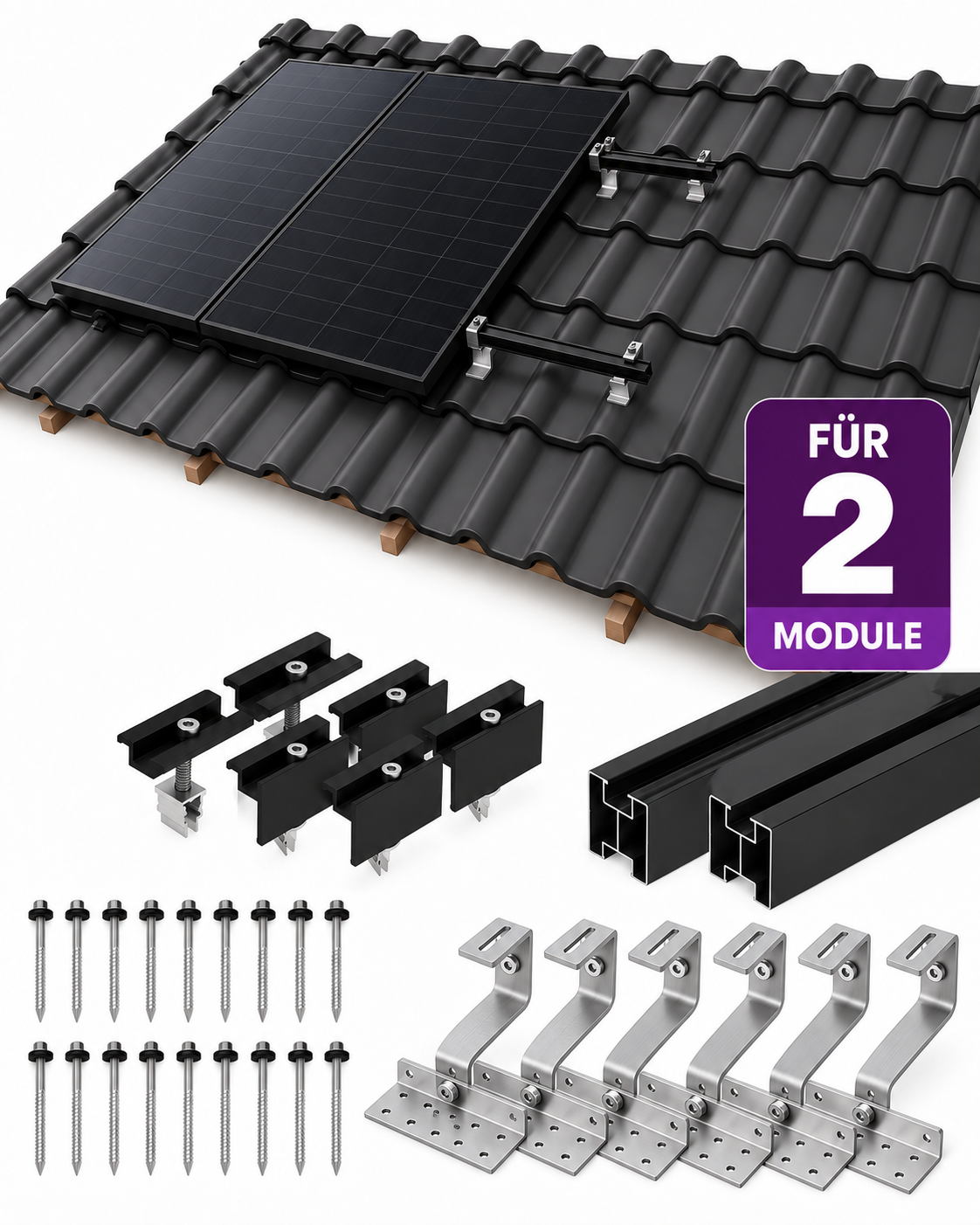
The Mounting Systems roof hook 170-7-40 is a high-quality and flexible fastening solution for photovoltaic systems on tiled roofs. Thanks to its 2-way adjustability it can be optimally adapted to different batten thicknesses and tile heights. This enables a tension-free installation of the substructure, even on uneven roof surfaces or with varying roof tile formats.Manufactured from robust stainless steel, this roof hook provides extremely high corrosion resistance and mechanical strength. It forms the stable foundation for the connection between the rafters and the mounting rails of your PV system.Highlights at a glanceMaximum flexibility: The 2-way adjustability allows the height under the cantilever (to the roof batten) as well as the vertical adjustment of the mounting rail.High-quality material: Manufactured from stainless steel (1.4301), which guarantees decades of durability and protection against the elements.High load capacity: The material thickness of 7 mm ensures superior stability and safety against high wind and snow loads.Optimum dimensions: With a base plate of 170 mm length, the hook offers a generous contact surface for secure screw fastening on the rafter.Time-saving installation: The slotted hole version on the cantilever allows tolerances to be easily compensated when installing the rails.Universally applicable: Suitable for most common kinds of pantile (e.g. Frankfurter Pfanne, Erlus, Braas).Areas of ApplicationThe roof hook is the ideal choice for demanding pitched roof installations:PV systems on tiled roofsSecure anchoring of the substructure directly into the rafter on standard coverings.Compensation for roof unevennessThanks to the adjustment option, “waves” in the roof can be compensated to achieve a visually perfect, flat module field.Regions with high loadsThanks to the solid 7 mm construction, it is particularly suitable for areas with increased structural requirements.Installation & Safety InstructionsProfessional screw connectionFasten the roof hook with at least two suitable pan head screws (stainless steel) directly into the rafter. Make sure the required screw-in depth is achieved.Tile recessThe overlying tile must be professionally worked with an angle grinder (flex) at the point where the hook emerges to avoid "tile breakage" due to direct contact.Maintain spacingEnsure that a gap of approx. 5 mm is maintained between the roof hook and the tile below to prevent load transfer to the tile. Properties CategoryRoof hook 170-7-40 Adjustability2-way adjustable Material thickness7 mm MaterialStainless steel (highly corrosion-resistant) Cantilever height40 mm (basic dimension) Base plate width170 mm Area of applicationTiled roofs (Frankfurter Pfanne and similar) Type of fasteningRafter mounting using wood screws Weather resistanceVery high / maintenance-free FAQs about the Mounting Systems roof hook 170-7-40Why is an adjustable roof hook better than a fixed one?Flexibility with the roof batten.Since roof battens can vary in thickness (e.g. 30 mm or 40 mm), this hook can be adjusted so that it does not rest on the lower tile and at the same time does not lift the upper tile.Does this hook fit all mounting rails?Yes, when using M10 hammer head screws.Using the slotted hole at the upper end of the hook, almost all standard aluminium profiles can be securely fastened with an M10 screw and locking nut.How many roof hooks do I need per module?Depending on statics.On average, around 2 to 2.5 roof hooks per module are calculated. In snowy areas or on the roof edge (wind load), however, the number may be significantly higher.Do I always have to flex the tiles?Yes, with standard pantiles.To ensure that the tiles lie flat again after installation and are not stressed by the hook, it is absolutely necessary to machine the tiles.
The Mounting Systems end clamp is a specialised fastening element that secures the end of a row of solar modules to the substructure. In this version, it is designed as a universal clamp that flexibly covers module frame heights from 30 to 40 mm. The specification "40 mm" refers to the width of the clamping surface or the length of the clamping body to ensure optimum force distribution on the frame.Thanks to the sophisticated design, the clamp automatically adapts to the respective frame thickness when tightened. This makes it an extremely efficient solution for installers, as only one clamp model needs to be stocked for different module types.Highlights at a glanceVariable clamping range: Suitable for all standard solar modules with a frame height between 30 mm and 40 mm.High stability: The 40 mm wide clamping surface ensures a secure hold and protects the module frame against point loads.Robust materials: Made from weather-resistant aluminium and stainless steel screws, ensuring permanent corrosion resistance.Easy adjustment: The elongated hole or integrated spring allows the clamp to be precisely positioned and tightened at the end of the rail.Universal compatibility: Suitable for standard Mounting Systems profile systems and comparable aluminium mounting rails.Secure row termination: Ensures that the outer modules remain firmly attached to the rail even at extreme wind speeds.Areas of applicationThe end clamp is used exclusively at the outer ends of a module field:Photovoltaic roof installationsFor securing the first and last module of a row on pitched or flat roofs.Single module installationFor installations of individual modules (e.g. balcony systems), a total of four end clamps are required, as there is no module transition.Commercial PV parksFor use in large-scale systems where fast and reliable installation of the module termination is required.Installation & safety instructionsCorrect positioningThe clamp must be flush with the module frame. Ensure that the clamping foot is securely anchored in the mounting rail slot.Tightening torqueTighten the screw with the torque recommended by the system manufacturer (usually between 8 and 10 Nm) to achieve optimum clamping force without deforming the material.Overhang of the railAllow the mounting rail to protrude approx. 2–5 cm beyond the module to provide sufficient space for the end clamp to anchor stably. Properties CategoryEnd clamp alu natural Clamping range (frame height)30 – 40 mm MaterialAluminium (high-strength) Colour / FinishAlu natural (silver) Clamp length40 mm Area of applicationEnd fastening of the module field CompatibilityMounting Systems rail profiles Mounting typeClick or screw fixing Weather resistanceUV-resistant and corrosion-resistant FAQs about the Mounting Systems end clampCan I use this clamp between two modules as well?No.Between two modules, centre clamps must be used as these fix both frames at the same time. The end clamp is shaped on one side only to hold just one frame at the end of the rail.Does the clamp fit both 30 mm and 40 mm frames equally?Yes.The mechanism is designed so that the clamp can be continuously tightened within this range. You just need to screw in the bolt until the clamping arm rests firmly on the module frame.Is this clamp also available in black?Yes.For full-black modules, Mounting Systems also offers this model in a black anodised version, so the fastening is not visually conspicuous on the dark frame.Is the clamp supplied as a set with screw and sliding block?As a rule, yes.Most variants are delivered as ready-to-install sets. However, please check in advance whether the included sliding block or click block (EC) matches your specific rail profile.
The Mounting Systems centre clamp is a universal connecting element for safely securing two adjacent solar modules to a substructure. This version is designed as a universal clamp and flexibly covers module frame heights from 30 to 40 mm. The specification "40 mm" refers to the width of the clamping surface, which ensures optimal load distribution on the frame edges.Thanks to the variable clamping range, the component automatically adapts to the respective frame thickness when tightened. This reduces complexity in material planning, as only one type of clamp is needed for various module generations.Highlights at a glanceFlexible clamping range: Suitable for solar modules with frame heights between 30 mm and 40 mm.Wide contact surface: The 40 mm wide clamping jaw ensures a stable hold and prevents damage to the module frame by localised pressure.High corrosion resistance: Made from high-quality aluminium and stainless steel screws for long-lasting resistance to weathering.Efficient installation: Allows simultaneous fixing of two modules with only one fixing point, reducing installation time per kilowatt-peak ($kWp$).Universal compatibility: Precisely fits common Mounting Systems profile systems as well as many cross-brand aluminium mounting rails.Symmetrical load distribution: The design ensures uniform contact pressure on both adjacent module frames.Areas of applicationThe centre clamp is used within a module field for connection:Photovoltaic rooftop systemsStandard fixing for pitched roof systems to securely connect rows of modules together.Commercial PV systemsUsed in large projects where the speed and reliability of components are critical.Multi-row module fieldsWherever more than one module per rail row is installed and a defined space (module gap) is required between the units.Installation & safety instructionsCentringThe centre clamp must be positioned exactly between the two module frames. Make sure that both frames are covered evenly by the clamp.Tightening torqueTighten the stainless steel screw to the recommended torque (usually 8–10 Nm). Too little tightening jeopardises storm resistance, too much tightening can deform the frame.Earthing / potential equalisationObserve the applicable regulations regarding earthing of the mounting system. Some centre clamps feature integrated earthing pins that pierce the anodised coating of the frame. Properties CategoryCentre clamp natural aluminium Clamping range (frame height)30 – 40 mm MaterialAluminium (high-quality anodised/natural) Colour / FinishNatural aluminium (silver) Clamp length40 mm Area of applicationConnection between two solar modules CompatibilityMounting Systems rail profiles Mounting methodClick or screw fixing Weather resistanceVery high / corrosion-resistant FAQs on the Mounting Systems centre clampCan I use this clamp for any solar module?Yes, provided the frame height is in the range of 30–40 mm.Most modern high-performance modules have frame thicknesses of 30 mm, 35 mm or 40 mm, making this clamp almost universally applicable.Is the distance between the modules specified by the clamp?Yes.The centre bar of the clamp creates a technical gap between the modules (usually approx. 20 mm). This gap is necessary for the thermal expansion of the rails and modules.Is the clamp supplied complete with sliding block?Usually, yes.The clamp is usually supplied as a set including screw and sliding block or click block. Check in advance if the block is compatible with your specific rail profile groove.Is this model also available for black module frames?Yes.For an aesthetically pleasing installation of full-black modules, this clamp is also available in a black anodised version available.
The Mounting Systems FD3 module support (front) is a central component of the FD3 flat roof system. This system is specially designed for ballast-optimised installation of photovoltaic systems on flat roofs with low load reserves. The front module support forms the low fixed point of the substructure and largely determines the angle of inclination of the solar modules.Made from high-quality, corrosion-resistant aluminium, the module support ensures a durable and secure connection between the floor rail and the front edge of the solar module. The aerodynamic design of the FD3 system minimises wind lift, significantly reducing the need for heavy ballast.Highlights at a glanceOptimised aerodynamics: Part of the overall FD3 system, which has been tested in a wind tunnel to ensure maximum stability with minimum counterweight.High material quality: Made of weather-resistant aluminium, ensuring a long service life without corrosion risk.Quick assembly: Thanks to pre-assembled components and simple screw connections, the front support can quickly be fixed to the floor rails.Precise inclination: In combination with the rear module support, a fixed installation angle (mainly 10° or 15°) is achieved for optimal yield.Protection of the roof covering: The system is installed without roof penetration; the module support distributes the loads evenly across the floor rails.Module-friendly fixation: The contact surfaces are designed so that the frames of the solar modules are securely held without causing mechanical stress.Areas of applicationThe FD3 module support front is the basic component for flat roof installations:Commercial flat roofsIdeal for large industrial halls with trapezoidal sheet metal or foil sealing, where the total weight of the system matters.Private houses with flat roofsSimple and visually discreet elevation for garages, carports or bungalows.East-west or south orientationThe module support can be flexibly used in various FD3 configurations, both for classical south-facing systems and roof area-optimised east-west systems.Installation & safety instructionsSystem networkThe front module support may only be used in combination with the original FD3 floor rails and the corresponding connectors to avoid jeopardising the structural approval.BallastingEnsure that the ballast required according to the structural plan (e.g., concrete blocks) is correctly placed on the rails, as the module support itself weighs nothing.Maintain distancesEnsure correct row distances during installation to prevent mutual shading of the modules. Properties CategoryFD3 module support front System compatibilityMounting Systems FD3 (flat roof) PositioningFront / Low side of the elevation MaterialHigh-strength aluminium / Stainless steel components Area of applicationFlat roof solar systems (Ballasted or Bolted) Installation methodModule clamping on FD3 substructure Weather resistanceVery high / Corrosion-resistant according to industry standard FunctionSecure anchoring of the module frame at the front Maintenance requirementMaintenance-free FAQs on the FD3 module support frontCan I adjust the angle of inclination flexibly?No.With the FD3 system, the inclination angle is determined by the fixed heights of the front and rear module supports (10° as standard). This provides high stability and easy wind load planning.Is the mounting material for fixing to the module included?Usually separate.The module support is attached to the floor rail. For securing the solar modules to the support, the appropriate centre and end clamps are required, which are matched to the frame height of your modules.Do I need protective mats?Yes, strongly recommended.To protect the roof membrane or bitumen sheet from mechanical damage by the floor rails, suitable protective mats (PADs) should always be placed under the system's contact points.How many front supports do I need?One support per module support point.Usually each module requires two support points at the front. Depending on the rail layout, one FD3 module support front is mounted per support point.
The Mounting Systems connecting rail with a length of 250 mm is an essential coupling element for photovoltaic substructures. It is used to securely and stably connect two aluminium mounting rails (profiles). Using this rail connector, endless rail strands can be achieved, which minimises the offcut rate and increases the static stability of the overall system over large spans.Manufactured from high-quality aluminium, the connector is precisely tailored to the inner or outer contour of the Mounting Systems profile series. It ensures flush alignment of the profiles and provides a smooth transition for the module clamps over the joint.Highlights at a glanceSeamless extension: Enables the stable connection of two rail sections to form a continuous supporting profile.Optimum leverage: With a length of 250 mm, the rail provides sufficient overlap on both sides of the joint for a high mechanical load capacity.Material quality: Made of weather-resistant aluminium, which harmonises perfectly with the mounting rails and prevents contact corrosion.Simple installation: Depending on the profile type, the connector is either inserted into the rail or attached from the outside and usually fixed without tools or with a few screws.Static safety: Supports the transmission of forces between the rail sections and helps prevent deflection at the joint edges.Versatile in use: Compatible with various Mounting Systems profiles (e.g. the MS+ or Pro series).Areas of applicationThe connecting rail is used wherever standard rail lengths are not sufficient:Large PV roof systemsConnecting standard profiles (e.g. 3.30 m or 4.40 m) to create long module rows on industrial or residential buildings.Minimising offcutsUseful utilisation of remaining rail sections by joining to form usable lengths.Open area installationsCreation of long rail strings for large-scale solar parks with easy transport of shorter individual profiles.Installation & safety instructionsCentring the connectorPosition the connector so that it is half (125 mm) in or on each of the rails to be joined.Observe expansion jointFor very long rail sections (usually from 12–15 metres), a thermal break must be planned. In this case, the connector must only be fixed firmly on one side to allow for the longitudinal expansion of the aluminium.Support by roof hooksIt is recommended to position the rail joint near a fixing point (e.g. roof hook or support), but not directly on it, to retain the flexibility of the system. Properties CategoryConnecting rail 250mm Length250 mm MaterialAluminium (high quality) Area of applicationConnecting two mounting rails CompatibilityStandard Mounting Systems profiles FunctionStatic coupling and rail extension Type of installationInsert or external connector Weather resistanceVery high / corrosion-proof MaintenanceMaintenance free FAQs on the Mounting Systems connecting railAre screws required for fastening?Depending on the model.Many modern connectors from Mounting Systems are designed as "insert connectors", which are held in place by clamping force or secured with self-drilling screws. Check whether your particular profile set requires additional locking screws.Is the connection as stable as a continuous rail?Nearly.If installed correctly, the joint achieves a very high degree of stability. Nevertheless, for structural reasons, a rail joint should ideally be located in the area of the lowest bending moment (close to the support points).Does this connector also fit third-party brands?Conditionally.As the rail connectors are precisely adapted to the geometry of the aluminium profiles (hollow chamber or side guide), they usually only work with the corresponding rails from Mounting Systems.Is there a version for black rails?Yes.For visually demanding projects with black profiles, the connector is often also available in a black anodised version so that it does not stand out in silver at the joint positions.
The Mounting Systems connecting rail O+W with a length of 800 mm is a specialised component for flat roof mounting systems in east-west orientation. It serves as a connecting element between the module supports (beams) of two back-to-back modules. This rail forms the static backbone to join the individual elevations together to create a stable unit while simultaneously ensuring the correct row spacing.Thanks to its generous length of 800 mm, it enables optimal force distribution within the system and offers sufficient space for ballasting. The rail is precisely matched to the requirements of aerodynamically optimised flat roof systems to ensure maximum stability even in high wind loads.Highlights at a glanceSpecialised for east-west: Optimised for coupling module rows in O+W systems to maximise roof area utilisation.High static stability: The length of 800 mm ensures a large-area load distribution and increases the rigidity of the overall substructure.Integrated ballast reception: Provides a level surface for safe placement of ballast blocks (e.g. paving slabs) directly at the centre of the structure.Weather-resistant aluminium: Made from high-quality material that remains permanently corrosion-free and harmonises perfectly with the other system components.Precision perforation: Features factory-prepared holes or oblong holes for quick and error-free screwing to the module supports.Aerodynamic compound: Supports the "cohesion" of the module field, which reduces the need for additional weighting due to the suction combination effect.Areas of applicationThis connecting rail is the key for efficient flat roof systems:East-west flat roof systemsConnecting the rear supports (ridge area) of two oppositely inclined modules.Large commercial installationsUsed on industrial halls where fast assembly and high area utilisation are the focus.Ballasted systems without roof penetrationWherever stability is achieved solely by the dead weight and mechanical connection of the rails.Installation & safety notesPrecise boltingUse only the stainless steel bolts and nuts specified by the manufacturer to connect the connecting rail to the supports.Protection of roof membraneSince the connecting rails often run close to the ground, a suitable building protection mat (PAD) should always be used under the contact points with the roof.Ballasting as per planPlace the calculated number of ballast blocks centrally on the connecting rail to achieve uniform pressure distribution on the roof structure. Properties CategoryConnecting rail O+W Length800 mm System typeMounting Systems FD3 (East-West) MaterialHigh-quality aluminium (corrosion-resistant) Area of applicationFlat roof elevation (O+W compound) FunctionCoupling of module rows / load distribution WeightOptimised for low roof load Weather resistanceVery high / UV-resistant Maintenance effortMaintenance-free FAQs on the connecting rail O+W 800 mmWhy is the rail exactly 800 mm long?For optimal module spacing.The length is dimensioned so that for standard module widths it creates the ideal "ridge distance" between the module backs to enable maintenance aisles and optimise aerodynamics.Can I place heavy concrete blocks on this rail?Yes.The rail is designed as a load-bearing element. However, ensure that the ballast is secured so that it cannot slip (e.g. with rail edges or additional retaining brackets).Is the rail laid directly on the roof?No, indirectly.It is usually mounted between the supports. If it runs close to the ground, a protective mat (building protection pad) must be placed between the rail and the roof membrane to prevent damage.Is the mounting material included in delivery?Usually separate.Usually you order the connecting rail as a single component. The necessary system screws (e.g. hammer head or hexagon head screws) are often part of a separate mounting kit.
The Mounting Systems ball lock pin 6x50 mm is a high-strength connecting element for quick and tool-free locking of system components. It is primarily used in mobile or modular substructures where parts frequently need to be adjusted, secured or released.Thanks to the integrated spring mechanism and the locking balls, the bolt provides a form-fit connection that can only be released by deliberately pressing the push button on the handle. This guarantees maximum safety against unintentional slipping out.Highlights at a glanceQuick release system: Enables components to be connected and disconnected in seconds without the use of spanners or other tools.Self-securing: The spring-loaded balls at the end of the bolt hold the element securely in the hole and prevent it from coming loose under vibration.High shear strength: Made of stainless steel or high-strength galvanised steel to ensure maximum stability even under mechanical stress.Easy handling: The ergonomic handle (often designed as a T-handle or mushroom head) allows comfortable operation, even when wearing work gloves.Weather resistant: Ideal for outdoor use in photovoltaic or event systems as the materials are resistant to corrosion.Precision dimensions: A diameter of 6 mm and an effective length of 50 mm ensure an exact fit in standardised system drill holes.Areas of applicationThe ball lock pin is a versatile securing element:Adjustable mounting bracketsSecuring telescopic supports or variable tilt angles in PV systems (e.g. seasonal adjustment).Modular carrier systemsQuick fixation of outriggers, diagonal braces or ballast troughs in flat roof or open-air constructions.Trade fair & event constructionConnection of aluminium trusses or frame elements that need to be assembled and disassembled regularly.Transport protectionLocking of moving parts on assembly frames during transport to the construction site.Installation & safety instructionsDiameter testMake sure that the mounting hole is exactly 6 mm (H11 tolerance recommended) to avoid play or tilting.Complete locking mechanismWhen inserting, make sure that the balls at the end of the bolt emerge completely and snap into place. This is the only way to ensure full tensile strength.CleaningKeep the spring mechanism and the balls free of sand or coarse dirt to maintain the smooth operation of the push button in the long term. Properties CategoryBall lock pin 6x50 Diameter (d1)6 mm Effective length (l1)50 mm Bolt materialStainless steel (rustproof) Locking typeDouble ball lock OperationPush button (self-locking) Area of applicationFD3 systems / quick connections Weather resistanceVery high / corrosion-resistant Special featureLoss protection via eyelet possible FAQs on the 6x50 mm ball lock pinCan the bolt replace a static screw connection?Only with appropriate design.A ball lock pin is primarily designed for shear forces. For load-bearing, permanent connections in PV statics, the system manufacturer's calculations must be observed. It is not a direct replacement for a firmly tightened M6 bolt with nut.Is there a captive lock for the bolt?Optionally available.Many users attach a retaining rope (stainless steel wire rope) to the handle of the bolt to prevent the bolt from being lost or falling off the roof when released.What does the "effective length" of 50 mm mean?The length of the shaft.The 50 mm refers to the area between the base of the handle and the start of the locking balls. The component package that is penetrated may therefore be a maximum of just under 50 mm thick.Is the bolt rustproof?As a rule, yes.Mounting Systems usually uses stainless steel variants for outdoor applications. Please check the specific material number (e.g. A2/A4) if use in extremely salty sea air is planned.
The Mounting Systems Universal ballast tray with a length of 1831 mm is a key component for the ballasted installation of photovoltaic systems on flat roofs. It is used to securely hold weighting materials (such as paving slabs or concrete blocks) when the static requirements for wind load securing exceed the substructure's own weight.Thanks to its universal design, it can be flexibly integrated into various flat roof systems from Mounting Systems. The generous length of 1831 mm allows the ballast to be distributed over a wide area, which minimises the point load on the roof structure whilst ensuring high stability at the same time.Highlights at a glanceHigh loading volume: Provides sufficient space for a large number of ballast blocks to guarantee maximum stability even in high wind load zones.Optimal load distribution: Thanks to its length of 1831 mm, the weight is transferred evenly into the base rails, protecting the roof covering.Weather-resistant material: Made of high-quality aluminium or galvanised steel (model-dependent) to provide long-lasting protection against corrosion.Universal compatibility: Suitable for different flat roof configurations, both for south and east-west orientations.Secure fixing: The tray shape prevents the ballast blocks from slipping or falling, even under strong vibrations or inclines.Easy system integration: The tray is screwed directly to the base or connecting rails, thus becoming an integral part of the structural system.Areas of applicationThe ballast tray is indispensable for penetration-free flat roof installations:Large-scale PV installations on industrial roofsSecuring large module areas against suction and pressure forces at wind speeds in accordance with DIN EN 1991 (Eurocode 1).Roofs with sensitive waterproofingWherever mechanical fixing (screwing) into the roof is prohibited for warranty reasons.Installations near the coast or in exposed locationsAdditional weighting option for systems exposed to extreme weather conditions.Installation & safety instructionsObserve static calculationThe exact amount of ballast (in kg) per tray must be specified in the project-specific structural analysis report.Protecting the roof coveringEnsure that sufficient protection mats are placed under the contact points of the tray or rails to avoid mechanical abrasion.Even loadingDistribute the stones evenly within the tray to prevent one-sided loading of the substructure. Properties CategoryTechnical data: Universal ballast tray Length1831 mm System compatibilityMounting Systems FD3 / Universal MaterialSteel (galvanised) / aluminium Area of applicationFlat roof photovoltaic systems FunctionSecure accommodation of ballast weights AdvantageProtecting the roof waterproofing Weather resistanceVery high / corrosion-protected Installation typeHook-in / screwing on base rail FAQs for the Universal Ballast Tray 1831 mmHow many paving slabs fit in one tray?Depending on the dimensions of the slabs.For standard paving slabs (40 x 40 cm or 50 x 50 cm), several dozen kilograms of ballast can be securely accommodated, depending on stacking and weight.Can the tray be retrofitted?Yes.Provided that the Mounting Systems rail system offers the corresponding mounting points, the tray can also be integrated during an extension or retrofit of the statics.Does the tray need its own drainage holes for rainwater?Usually integrated.The tray design usually provides for water to drain freely to prevent waterlogging and uncontrolled weight gain due to water accumulation.Is the mounting material for rail fixing included?Usually supplied separately.The ballast tray is usually supplied as an individual item. The required system screws and sliding blocks should be ordered in accordance with the parts list for the mounting system.
The Mounting Systems EW XL base rail with a length of 2287 mm is the load-bearing base element for aerodynamic flat roof mounting systems in east-west orientation (EW). The "XL" version is specially optimised for accommodating large-format solar modules (multi-cell modules), which have a greater width or length than standard modules.This rail is placed directly on the roof membrane (using building protection mats) and serves as a stable base for the front and rear module supports. Due to its precise manufacturing and integrated mounting points, it enables rapid, modular assembly of the entire rail system without roof penetration.Highlights at a glanceExtra-long (XL): With a length of 2287 mm, the rail offers ample space for modern, large surface PV modules and the necessary clearances for aerodynamics.High static rigidity: The special aluminium profile is designed for high mechanical loads, to safely absorb wind and snow loads.Tool-optimised: Features prefabricated slots and hole patterns that allow precise positioning of the module supports and connectors.Ballast-optimised: The geometry of the base rail allows for easy and secure placement of ballast stones to weigh down the system.Weather-resistant aluminium: Permanent protection against corrosion, even with standing moisture on flat roofs.System integrity: Perfectly matched to the EW components from Mounting Systems for a form-fit and stable connection.Areas of applicationThe XL base rail is the backbone for large-scale flat roof projects:East-west elevations (10°/15°)Coupling two modules "back to back" for optimal use of roof space with even energy production throughout the day.Industrial & commercial roofsUsed on bitumen, foil or gravel roofs, where a ballasted solution without damaging the roof membrane is required.Large format modulesEspecially for PV modules with a width over 1.10 m or other custom dimensions that require a longer base.Installation & safety instructionsBuilding protection mats (PADs)Always place suitable building protection mats beneath the base rail to protect the roof membrane from mechanical damage and plasticiser migration.AlignmentEnsure the base rails are aligned exactly parallel to each other to avoid tension in the module field and installation problems with the connectors.Ballasting according to staticsThe rail serves as a carrier for the ballast. The exact position and quantity of stones must be taken from the project-specific structural plan. Properties CategoryEW XL base rail Length2287 mm System compatibilityMounting Systems FD3 (East-West XL) MaterialAluminium (EN AW-6063 T66) Area of applicationFlat roof (elevation for large modules) FunctionBase profile / load bearing and connection WeightOptimised for low static roof load Weather resistanceVery high / corrosion-free MaintenanceMaintenance-free FAQs on the EW XL 2287 mm base railWhy is the rail 2287 mm long?For double module structure.In an east-west system, two modules are mounted opposite to each other. The length of 2287 mm covers the base area of both modules, including the necessary clearances for ridge coupling and aerodynamic optimisation.Can I also use this rail for a purely south-facing orientation?Conditionally.Basically, this profile is perforated for Mounting Systems' EW system. For south-facing systems, there are often specific base rails with different lengths and hole patterns (e.g. S systems).How are the rails connected to each other?Via cross-connecting rails.The stability of the field is achieved by screwing the base rails to cross connectors. This creates a continuous grid that jointly absorbs wind loads.Is the aluminium walkable?Yes, during installation.The rail is stable enough to be carefully walked on during installation. Nevertheless, point loads directly on the roof membrane should be avoided.