
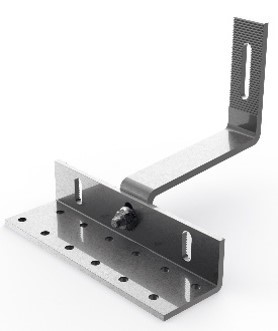

MOUNTING SYSTEMS roof hook 170-7-40 – 2-way adjustable
Product information
The Mounting Systems roof hook 170-7-40 is a high-quality and flexible fastening solution for photovoltaic systems on tiled roofs. Thanks to its 2-way adjustability it can be optimally adapted to different batten thicknesses and tile heights. This enables a tension-free installation of the substructure, even on uneven roof surfaces or with varying roof tile formats.
Manufactured from robust stainless steel, this roof hook provides extremely high corrosion resistance and mechanical strength. It forms the stable foundation for the connection between the rafters and the mounting rails of your PV system.
Highlights at a glance
- Maximum flexibility: The 2-way adjustability allows the height under the cantilever (to the roof batten) as well as the vertical adjustment of the mounting rail.
- High-quality material: Manufactured from stainless steel (1.4301), which guarantees decades of durability and protection against the elements.
- High load capacity: The material thickness of 7 mm ensures superior stability and safety against high wind and snow loads.
- Optimum dimensions: With a base plate of 170 mm length, the hook offers a generous contact surface for secure screw fastening on the rafter.
- Time-saving installation: The slotted hole version on the cantilever allows tolerances to be easily compensated when installing the rails.
- Universally applicable: Suitable for most common kinds of pantile (e.g. Frankfurter Pfanne, Erlus, Braas).
Areas of Application
The roof hook is the ideal choice for demanding pitched roof installations:
- PV systems on tiled roofs
- Secure anchoring of the substructure directly into the rafter on standard coverings.
- Compensation for roof unevenness
- Thanks to the adjustment option, “waves” in the roof can be compensated to achieve a visually perfect, flat module field.
- Regions with high loads
- Thanks to the solid 7 mm construction, it is particularly suitable for areas with increased structural requirements.
Installation & Safety Instructions
- Professional screw connection
- Fasten the roof hook with at least two suitable pan head screws (stainless steel) directly into the rafter. Make sure the required screw-in depth is achieved.
- Tile recess
- The overlying tile must be professionally worked with an angle grinder (flex) at the point where the hook emerges to avoid "tile breakage" due to direct contact.
- Maintain spacing
- Ensure that a gap of approx. 5 mm is maintained between the roof hook and the tile below to prevent load transfer to the tile.
Properties
| Category | Roof hook 170-7-40 |
|---|---|
| Adjustability | 2-way adjustable |
| Material thickness | 7 mm |
| Material | Stainless steel (highly corrosion-resistant) |
| Cantilever height | 40 mm (basic dimension) |
| Base plate width | 170 mm |
| Area of application | Tiled roofs (Frankfurter Pfanne and similar) |
| Type of fastening | Rafter mounting using wood screws |
| Weather resistance | Very high / maintenance-free |
FAQs about the Mounting Systems roof hook 170-7-40
Why is an adjustable roof hook better than a fixed one?
Flexibility with the roof batten.
- Since roof battens can vary in thickness (e.g. 30 mm or 40 mm), this hook can be adjusted so that it does not rest on the lower tile and at the same time does not lift the upper tile.
Does this hook fit all mounting rails?
Yes, when using M10 hammer head screws.
- Using the slotted hole at the upper end of the hook, almost all standard aluminium profiles can be securely fastened with an M10 screw and locking nut.
How many roof hooks do I need per module?
Depending on statics.
- On average, around 2 to 2.5 roof hooks per module are calculated. In snowy areas or on the roof edge (wind load), however, the number may be significantly higher.
Do I always have to flex the tiles?
Yes, with standard pantiles.
- To ensure that the tiles lie flat again after installation and are not stressed by the hook, it is absolutely necessary to machine the tiles.
Login
Customers also bought
The Mounting Systems centre clamp is a universal connecting element for safely securing two adjacent solar modules to a substructure. This version is designed as a universal clamp and flexibly covers module frame heights from 30 to 40 mm. The specification "40 mm" refers to the width of the clamping surface, which ensures optimal load distribution on the frame edges.Thanks to the variable clamping range, the component automatically adapts to the respective frame thickness when tightened. This reduces complexity in material planning, as only one type of clamp is needed for various module generations.Highlights at a glanceFlexible clamping range: Suitable for solar modules with frame heights between 30 mm and 40 mm.Wide contact surface: The 40 mm wide clamping jaw ensures a stable hold and prevents damage to the module frame by localised pressure.High corrosion resistance: Made from high-quality aluminium and stainless steel screws for long-lasting resistance to weathering.Efficient installation: Allows simultaneous fixing of two modules with only one fixing point, reducing installation time per kilowatt-peak ($kWp$).Universal compatibility: Precisely fits common Mounting Systems profile systems as well as many cross-brand aluminium mounting rails.Symmetrical load distribution: The design ensures uniform contact pressure on both adjacent module frames.Areas of applicationThe centre clamp is used within a module field for connection:Photovoltaic rooftop systemsStandard fixing for pitched roof systems to securely connect rows of modules together.Commercial PV systemsUsed in large projects where the speed and reliability of components are critical.Multi-row module fieldsWherever more than one module per rail row is installed and a defined space (module gap) is required between the units.Installation & safety instructionsCentringThe centre clamp must be positioned exactly between the two module frames. Make sure that both frames are covered evenly by the clamp.Tightening torqueTighten the stainless steel screw to the recommended torque (usually 8–10 Nm). Too little tightening jeopardises storm resistance, too much tightening can deform the frame.Earthing / potential equalisationObserve the applicable regulations regarding earthing of the mounting system. Some centre clamps feature integrated earthing pins that pierce the anodised coating of the frame. Properties CategoryCentre clamp natural aluminium Clamping range (frame height)30 – 40 mm MaterialAluminium (high-quality anodised/natural) Colour / FinishNatural aluminium (silver) Clamp length40 mm Area of applicationConnection between two solar modules CompatibilityMounting Systems rail profiles Mounting methodClick or screw fixing Weather resistanceVery high / corrosion-resistant FAQs on the Mounting Systems centre clampCan I use this clamp for any solar module?Yes, provided the frame height is in the range of 30–40 mm.Most modern high-performance modules have frame thicknesses of 30 mm, 35 mm or 40 mm, making this clamp almost universally applicable.Is the distance between the modules specified by the clamp?Yes.The centre bar of the clamp creates a technical gap between the modules (usually approx. 20 mm). This gap is necessary for the thermal expansion of the rails and modules.Is the clamp supplied complete with sliding block?Usually, yes.The clamp is usually supplied as a set including screw and sliding block or click block. Check in advance if the block is compatible with your specific rail profile groove.Is this model also available for black module frames?Yes.For an aesthetically pleasing installation of full-black modules, this clamp is also available in a black anodised version available.