
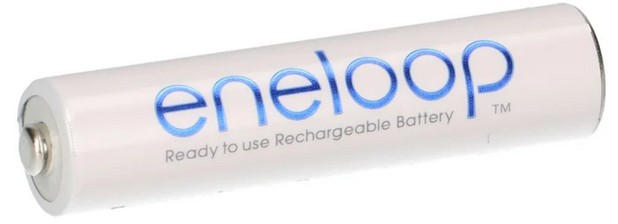



Panasonic Eneloop AAA NiMH rechargeable battery BK-4MCCF 1.2V 750mAh (Industrial)
Product information
The Panasonic Eneloop BK-4MCCF in the industrial version is the universal and extremely durable rechargeable battery in AAA (Micro) size. It has been specially developed for professional and industrial continuous use, where maximum reliability and a maximum number of cycles are paramount. With a nominal voltage of 1.2V, a capacity of 750 mAh and up to 2100 recharges, it is the most economical and sustainable energy solution for a wide range of devices. The unique Eneloop technology combines the advantages of a rechargeable battery with those of a single-use battery: it comes pre-charged, has excellent storage properties and is ready for immediate use.
Highlights at a glance
- Extreme longevity: Rechargeable up to 2100 times for maximum economy and sustainability.
- Extremely low self-discharge: Retains most of its original charge even after years of storage.
- Universally applicable: The ideal all-rounder for devices with medium energy requirements such as DECT telephones or remote controls.
- Industrial version: Supplied as a loose cell for easy assembly and direct use in manufacturing (OEM).
- Stable voltage: Provides reliable performance even at low temperatures.
Reliable power for professional applications
The Eneloop battery is the ideal power source for devices that are regularly used and charged. It is the first choice for equipping cordless DECT telephones in office environments, for remote controls in hotel and conference technology, for medical devices and measuring instruments as well as for solar-powered outdoor applications. Its extremely high cycle stability makes it the perfect solution for all applications where a long and low-maintenance service life is important.
Superior Eneloop technology
The unique technology of Panasonic Eneloop solves the biggest problem of conventional NiMH batteries: self-discharge. Thanks to an improved material composition and grid alloy, the Eneloop remains charged even when not in use for years. This makes it the ideal component for devices that are not used daily but need to function immediately when required, and significantly simplifies storage for industrial purposes.
Powerful and environmentally friendly
Eneloop batteries impress with a stable voltage curve and reliable function even at low temperatures. They are delivered pre-charged with environmentally friendly solar energy and are free from harmful heavy metals. Due to the high number of recharges, they replace thousands of single-use batteries, which not only reduces operating costs but also actively helps to protect the environment.
Features
| Model | Panasonic Eneloop AAA BK-4MCCF (industrial cell) |
| Technology | NiMH (low self-discharge) |
| Nominal voltage (V) | 1.2 |
| Capacity (mAh) | 800 (min. 750) |
| Cycle stability | up to 2100 recharges |
| Dimensions (Ø x H in mm) | 10.5 x 44.5 |
| Connection | Industrial cell (flat terminal) |
| Weight (g) | approx. 13 |
FAQs about the Panasonic Eneloop battery (Industrial)
What is the difference between the "Industrial" version and the normal Eneloop?
The battery cell itself is identical. The difference lies in the packaging and distribution channel. The "Industrial" version is supplied as bulk goods in packaging units suitable for industrial use and is aimed at commercial customers and original equipment manufacturers (OEMs) who install the cells directly into devices or assemble them into battery packs. The normal version is available in an end-user blister pack for retail sale.
What is the difference between the white Eneloop and the black Eneloop Pro?
The white standard Eneloop (this model) is designed for a maximum number of charge cycles (up to 2100) and extremely long life. It is the ideal all-rounder. The black Eneloop Pro has a higher capacity (approx. 930 mAh) for very energy-intensive devices, but offers fewer charge cycles (approx. 500).
Which charger should I use to charge these batteries?
To achieve maximum lifespan and performance, the use of a high-quality, microprocessor-controlled charger is recommended, which monitors each cell individually and gently terminates the charging process (e.g. by minus delta U shutoff).
How should this battery be disposed of?
Batteries must not be disposed of with household waste. As an industrial end-of-life battery, it is subject to the provisions of the Battery Act. Please return the used battery to the designated industrial or municipal collection points (e.g. GRS Batteries) to ensure proper and environmentally friendly recycling.
Login