
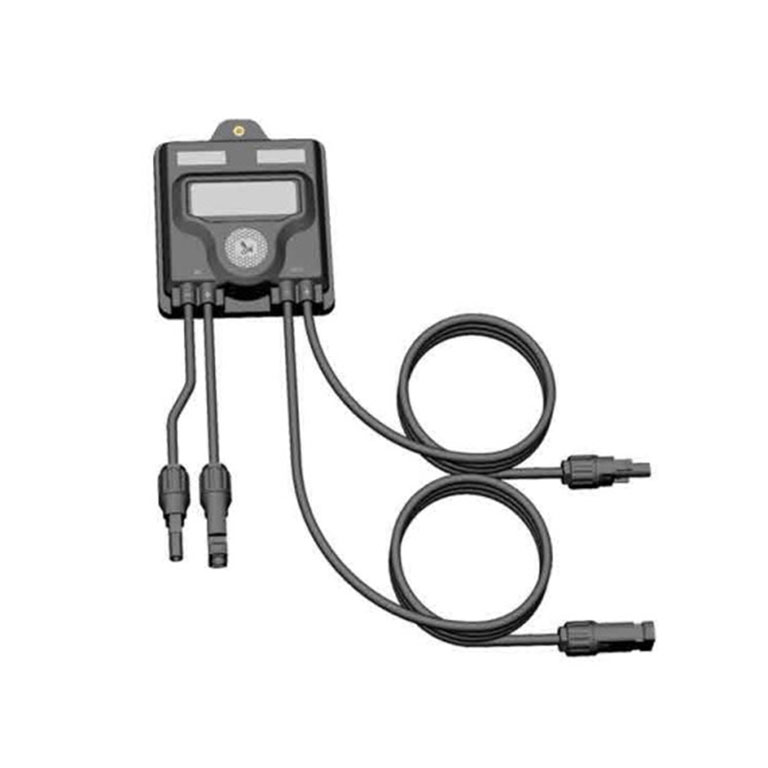


GNE Honeybee 650 Power Optimizer – Universal f
Product information
The GNE Honeybee 650 is a powerful DC power optimiser specifically designed to maximise the energy yield of photovoltaic systems in the event of shading, soiling or varying module orientation. Unlike closed systems (such as SolarEdge), the Honeybee 650 is universally compatible. It works with almost every standard string inverter (e.g. SMA, Fronius, Kostal, Growatt, Deye).
Thanks to module-level MPPT (Maximum Power Point Tracking), this optimiser ensures that each solar module delivers its maximum output independently of the rest of the string. A shaded module therefore no longer reduces the output of the entire string. This makes the Honeybee 650 the ideal, cost-effective retrofit solution for existing installations or for complex new roofs.
Highlights at a glance
- Universal compatibility: Works with almost all standard inverters and module types on the market, ideal for retrofits.
- Selective use: You do not have to equip all modules; it is often sufficient to fit only the affected (shaded) modules with an optimiser.
- High load capacity: Designed for modern high-performance modules up to 650 watts output and 15 amps input current.
- Shading management: Eliminates mismatch losses caused by shade (chimney, dormer, trees), dirt or ageing.
- Real-time monitoring: In combination with the (optional) Beehive base station, monitoring at module level is possible.
- Safety shutdown: Offers (with optional accessories) rapid shutdown functions for greater safety in the event of a fire.
- Robust design: IP68-certified housing for long-lasting weather resistance and durability on the roof.
Areas of application
- Shading: Roofs with moving shade caused by dormers, chimneys, satellite dishes or trees.
- Different orientations: Strings distributed across several roof surfaces (e.g. east/west) or pitch angles.
- Module mix: Systems in which (e.g. due to repair) different module outputs must be combined in one string.
- Repowering: Retrofitting old systems to compensate for degradation losses.
Installation & safety instructions
- Observe the sequence: Connect first the optimisers to the solar modules and then connect the outputs of the optimisers to the string. Only at the very end is the string connected to the inverter.
- Selective vs. full expansion: The Honeybee 650 can be used selectively (only on shaded modules) to save output. However, if you require monitoring (monitoring each individual module via app), you must equip all modules in a string with an optimiser as well as the additional communication unit (Beehive Gateway).
- Spacing: When mounting on the frame, ensure that the rear side of the optimiser (cooling surface) has a little air gap to the rear side of the module to ensure good heat dissipation.
Specifications
| Model | GNE Honeybee 650 |
| Max. module output | **650 W** |
| Max. input voltage | **75 V** |
| Max. input current | **16 A** |
| MPPT voltage range | 12 V - 75 V |
| Max. efficiency | **99.6 %** |
| Connector type | **MC4 compatible** (Evo2) |
| Protection rating | **IP68** (Fully waterproof) |
| Operating temperature | -40°C to +85°C |
| Dimensions (without cable) | 130.5 x 113 x 26 mm |
FAQs about the GNE Honeybee 650
Can I also use this optimiser with a SolarEdge inverter?
No. SolarEdge inverters necessarily require SolarEdge's own optimisers, as these are firmly integrated into the inverter control system. The GNE Honeybee is intended for all other (classic) string inverters (SMA, Fronius, Huawei etc.).
Do I need an additional device for optimisation?
No. For pure power optimisation (shade management), the Honeybee 650 works autonomously. It starts working as soon as current flows. You only need additional devices (Beehive Data Logger) if you want to see the data of each individual module on your mobile phone or require active rapid shutdown.
What is the difference compared to the Tigo TS4-A-O?
Functionally, both are very similar (universal optimisers up to 700W/650W). GNE often positions the Honeybee as an attractively priced alternative. Both systems use similar radio technologies for monitoring, but are not compatible with each other (you cannot mix Tigo and GNE in the same string).Login