
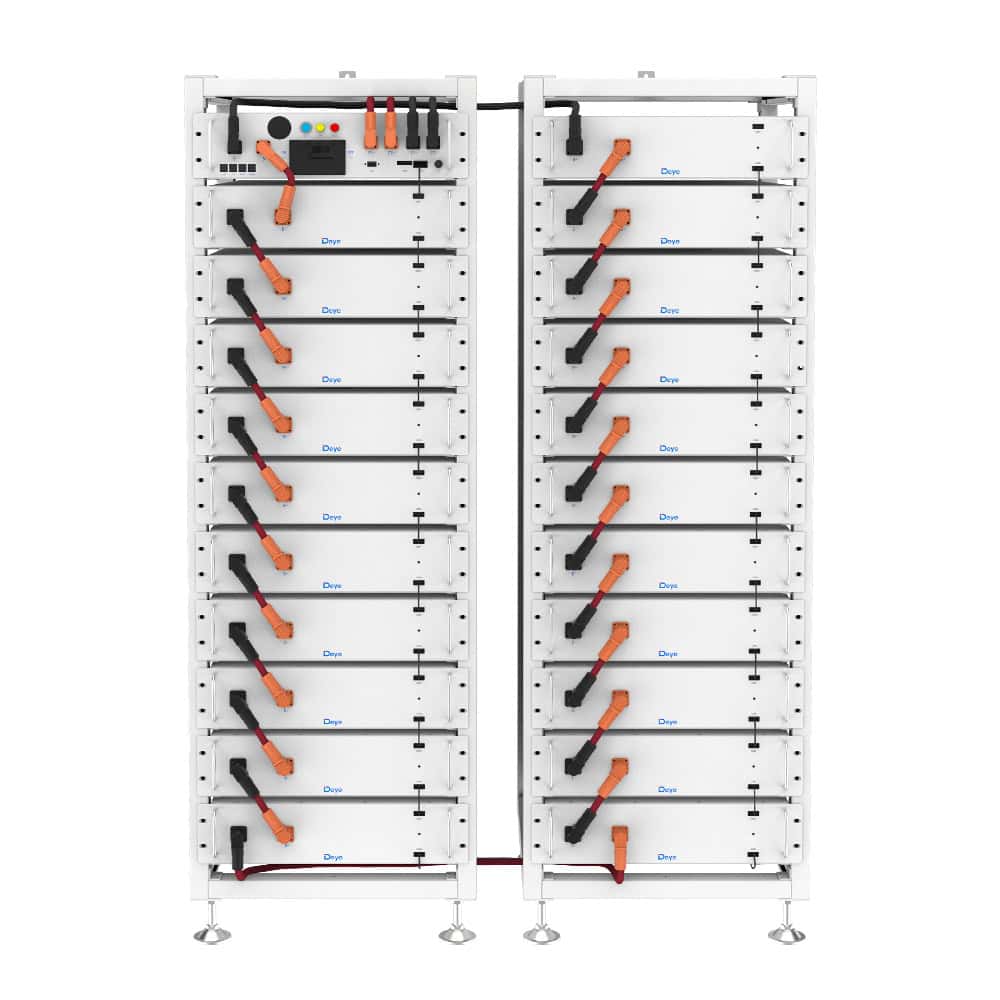


Deye BOS-A – 53.76 kWh high-voltage battery storage system for commercial and industrial use
Product information
The Deye BOS-A System in the 53.76 kWh configuration is a high-performance, modular high-voltage storage solution developed specifically to meet the requirements of commercial enterprises, industrial facilities and larger PV projects. Based on the robust BOS-A battery module (7.68 kWh per unit), this system provides a reliable energy reserve for emergency power supply and for optimising self-consumption of renewable energy.
By using the secure Lithium iron phosphate technology (LiFePO4) and an intelligent, cloud-based management system ensures the storage system offers maximum reliability and efficiency. The system is optimised for installation in rack environments and allows for quick installation and straightforward maintenance in a professional setting.
Key features at a glance
- High capacity: With a capacity of 53.76 kWh (achieved by 7 modules connected in series), the system offers substantial reserves for commercial applications, emergency power solutions and load management.
- Safe LiFePO4 chemistry: The cobalt-free cell chemistry ensures maximum thermal stability and an extremely long service life of over 6,000 cycles.
- Intelligent cloud management: Real-time monitoring of energy consumption and battery status via the Deye cloud platform to optimise operating costs.
- High-voltage efficiency: The series connection of the modules ensures a high system voltage, which minimises conversion losses and improves the efficiency of the overall system.
- Effortless installation: The embedded design and a module weight of approx. 70 kg allow for structured installation in standard rack systems.
- Robust industrial design: High protection standards and resistance to a variety of environmental conditions enable long-term use in technical rooms.
- Comprehensive warranty: A 10-year manufacturer’s warranty and a full replacement guarantee for up to 6,000 charge cycles provide long-term investment security.
Areas of application
The 53.76 kWh version of the BOS-A is the ideal solution for demanding projects in commercial and industrial settings:
- Industrial & commercial enterprises
- Ensuring an uninterruptible power supply (UPS) for critical machinery and reducing peak loads during operation.
- Larger photovoltaic systems
- Efficient temporary storage of solar power to maximise the self-consumption rate in office buildings, agricultural businesses or smaller production sites.
- Neighbourhood energy storage
- A centralised storage solution for residential estates or local authority energy projects for the shared use of solar power.
Installation & Safety Instructions
- Rack configuration
- The system achieves its capacity by connecting 7 battery modules in series per rack. Ensure that they are securely fastened in the control cabinet.
- Safety management
- The integrated Smart-BMS protects each module individually against overcharging, deep discharge and short circuits. Communication takes place seamlessly via CAN 2.0.
- Structural analysis & weight
- A fully equipped 53.76 kWh rack weighs approx. 500–600 kg. Ensure that the foundation at the installation site is designed to support these loads.
Features
| Model (System) | Deye BOS-A – 53.76 kWh |
| Nominal voltage (module) | 38.4 V |
| System nominal voltage (7 modules) | 268.8 V |
| System capacity (7 modules) | 53.76 kWh |
| Battery type | LiFePO4 (cobalt-free) |
| Max. charge/discharge current | 100 A |
| Recommended depth of discharge | 90% (DoD) |
| Cycle life | ≥ 6,000 cycles |
FAQs on the Deye BOS-A 53.76 kWh storage system
Can the 53.76 kWh system be expanded further?
Yes. Multiple racks can be connected in parallel to achieve larger total capacities for commercial or industrial applications. The modular design allows the system to be tailored precisely to growing energy requirements.
How does the emergency power supply work at this scale?
Automatic and powerful. When combined with a suitable Deye high-voltage inverter, the system can switch to battery operation within milliseconds in the event of a power cut and continue to reliably supply power to essential loads.
Why is the BMS so important in this system?
For balance and safety. When 7 modules are connected in series, the BMS ensures that all cells are charged and discharged evenly. This prevents individual modules from ageing prematurely and maximises the usable energy of the entire storage block.
Does the system require a lot of maintenance?
No. Thanks to the fanless design of the battery modules and the robust LiFePO4 technology, the system is virtually maintenance-free. Remote monitoring via the cloud also makes it possible to detect irregularities at an early stage, before they become a problem.
Login