
Deye BOS-G-Pack5.1 – 5.12 kWh high-voltage battery module for Deye BOS-G Pro systems

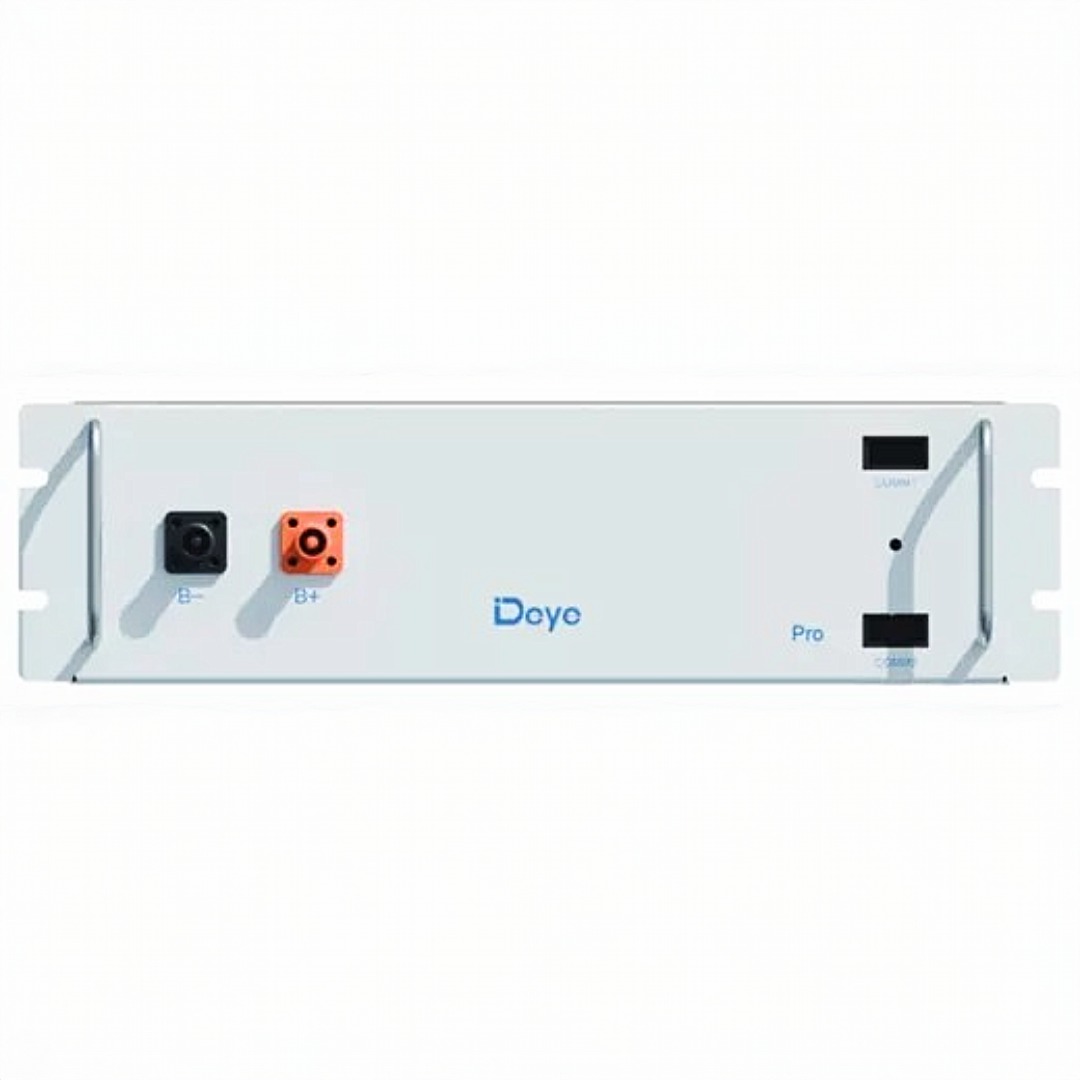


Product information
The Deye BOS-G-PRO-Pack5.1 is a state-of-the-art, high-voltage-capable lithium iron phosphate battery module (LiFePO4), specially developed for use in commercial and demanding private photovoltaic systems. It replaces confusing individual solutions with a modular, highly efficient system and at the same time offers intelligent functions to optimise storage performance.
With its sophisticated design, the BOS-G-PRO-Pack5.1 is not just a pure energy storage unit, but serves as a future-proof modular storage solution for your energy independence. It supports seamless integration with Deye high-voltage inverters and ensures that your system can call up maximum performance at any time.
Highlights at a glance
- High safety: The proven lithium iron phosphate chemistry (LiFePO4) offers maximum thermal stability and longevity with minimal self-discharge risk.
- Modular 19-inch design: The compact 3U standard format enables quick, uncomplicated rack mounting and flexible scalability of the overall system.
- Outstanding cycle stability: With over 6,000 charge cycles (with a recommended depth of discharge of 90%), the module guarantees an extremely long service life.
- Intelligent BMS: Integrated protection functions against deep discharge, overcharging, overcurrent and extreme temperatures ensure fully automatic cell balancing.
- Safety functions: A comprehensive battery management system ensures worry-free operation around the clock.
- Future-proof capacity: Enables flexible expansion from smaller commercial storage systems through to industrial large-scale projects in the megawatt range.
Areas of application
The Deye BOS-G-PRO-Pack5.1 is the perfect addition for commercial PV systems and demanding private homes:
- Private homes & prosumers: Maximisation of self-consumption of solar power and ensuring a reliable emergency power supply for the entire building.
- Trade & industry: Shaving peak loads and optimising operating costs through efficient intermediate storage of inexpensive solar power.
- Agriculture & skilled trades: Clear and scalable storage of energy in order to operate energy-intensive machines and systems (e.g. cooling systems or workshops) autonomously.
Installation & safety instructions
- Minimum system size: To set up a functional high-voltage system (BOS-G25 Pro), at least 5 battery modules connected in series are required.
- Control unit (PDU): In addition to the battery modules, a suitable master control unit (High Voltage Cluster Control Box) is absolutely required for battery management and protection.
- Transport & installation: Due to the dead weight of approx. 45 kg per module, installation in the rack cabinet should be carried out by at least two people or with suitable lifting equipment.
Features
| Category | Deye BOS-G-PRO-Pack5.1 |
|---|---|
| Nominal capacity | 100 Ah (5.12 kWh) |
| Battery type | Lithium iron phosphate (LiFePO4) |
| Nominal voltage | 51.2 V DC (high-voltage system) |
| Nominal discharge current | 100 A (max. 120 A for 2 min.) |
| Cycle life | ≥ 6000 cycles (at 25°C) |
| Depth of discharge (DoD) | 90 % |
| Protection class | IP20 (rack mounting) |
| Communication | CAN 2.0 / RS485 |
| Operating temperature range | Charging: 0~55°C / Discharging: -20~55°C |
| Expandability | Modular (up to 16 clusters in parallel) |
FAQs about the DEYE BOS-G-PRO-Pack5.1
Can a single module be connected directly to a high-voltage inverter?
- No. As this is a high-voltage system, at least 5 modules must be connected in series in order to achieve the required system voltage. In addition, a master control unit (PDU) is absolutely necessary.
How long does the manufacturer's warranty on the module apply?
- 10 years. Deye grants a long-term manufacturer's warranty of 10 years on the battery module, provided it is operated within the specified operating conditions and temperature windows.
Is the BMS included with the individual module?
- Partially. Each module has an integrated sub-BMS for monitoring its own cells. However, the higher-level control and communication with the inverter is handled by the master control unit (PDU), which must be purchased separately.
Login